
Zero Downtime, High Yield, AI-Driven Vision
Cement manufacturing is inherently energy-intensive, with thermal energy accounting for nearly 40% of total production costs. The kiln—the heart of every cement plant—operates at temperatures above 1,450°C, requiring consistent heat input to ensure uniform clinker formation and process efficiency. Any fluctuation in fuel quality or combustion rate directly impacts kiln energy efficiency, fuel consumption, and production costs.
Traditionally, cement plants relied on fossil fuels such as coal and petcoke for their stable calorific values. However, growing environmental regulations and the drive to reduce cement plant energy consumption have encouraged the shift toward alternate fuels like Refuse-Derived Fuel (RDF), biomass, and industrial or municipal waste. While these alternative fuels reduce emissions and costs, they vary widely in composition and energy content.
However, achieving accurate calorific value estimation is complex due to alternate fuel heterogeneity, inconsistent moisture content, and data integration challenges. Real-time calorific value monitoring is therefore crucial for kiln stability, maintaining consistent combustion and heat balance. Modern AI-based systems now address these challenges, improving fuel efficiency, stability, and emission control in cement production.
Manufacturers worldwide are actively reducing their dependence on traditional fossil fuels such as coal, petcoke, and natural gas, and shifting toward Alternative Fuels and Raw Materials (AFR) to help cement plants lower carbon emissions while utilizing waste streams from other industries.
Some cement plants in Europe already use up to 80% alternative fuels, setting up a benchmark for sustainable operations. Notable examples include projects in the Netherlands and Spain, where sewage sludge is successfully co-processed in cement kilns as both a fuel and a raw material, supporting efficient waste management and resource recovery.
By 2050, the global cement industry could meet up to 60% of its kiln energy needs from alternative fuels — with biomass contributing around 40% — potentially reducing fuel-related CO₂ emissions by approximately 27%.
Common alternate fuels used in cement production include biomass, refuse-derived fuel (RDF), tire-derived fuel (TDF), municipal solid waste, and plastic residues. These waste-derived fuels not only reduce dependence on fossil fuels but also divert large volumes of waste from landfills, promoting a circular and sustainable economy. By increasing the use of such fuels in cement kilns, manufacturers can achieve higher Thermal Substitution Rates (TSR), effectively replacing fossil fuel consumption and significantly reducing carbon emissions during clinker production .
In cement manufacturing, Calorific Value (CV) is a key parameter that shows how much heat energy a fuel can produce when it burns completely. It helps determine how efficiently a kiln can operate and how much energy is needed to form clinker. Fuels with a higher calorific value produce more heat and therefore contribute to better kiln performance and energy savings.
There are two common types of calorific value:
Calorific value is usually measured in kilocalories per kilogram (kcal/kg) or megajoules per kilogram (MJ/kg). It varies based on the fuel’s composition, moisture, and ash content. Understanding the calorific value is essential for achieving consistent combustion efficiency and maintaining stable kiln operation.
Accurately estimating the calorific value of fuels is essential for efficient cement production. It helps maintain the correct fuel-to-air ratio in kiln burners, ensuring a steady flame temperature and consistent energy utilization. When the calorific value is available in real time, plant operators can quickly adjust fuel feed rates to prevent overfeeding or underfeeding, which can otherwise lead to energy loss or unstable kiln conditions.
Reliable calorific value estimation also plays a key role in achieving a higher Thermal Substitution Rate (TSR) — a key performance indicator in the cement industry that measures how much of the total thermal energy used in the kiln comes from alternative fuels instead of traditional fossil fuels like coal or petcoke. A stable calorific value allows cement plants to safely increase the use of waste-derived and biomass fuels while maintaining clinker quality and overall process stability.
Calorific Value Estimation of Alternative and Waste-Derived Fuels in cement production is much more complex than conventional fossil fuels. These fuels vary greatly in composition, moisture, and combustion properties, which makes achieving accurate and consistent calorific value readings difficult. Below are the main challenges faced during calorific value estimation:
Alternative Fuels and Raw Materials (AFR), including Refuse-Derived Fuel (RDF) and biomass, consist of a diverse mix of materials such as paper, plastics, rubber, textiles, wood, and other industrial or municipal wastes — each with different heating values. This variation causes frequent fluctuations in calorific value, leading to temperature instability within the kiln and directly impacting the clinker burning zone and overall production stability.
AFR used in the cement industry often contains variable moisture levels, which directly impact its net calorific value (NCV). Fuels with high moisture generate less heat during combustion, leading to reduced thermal efficiency and unstable kiln temperatures. This inconsistency makes it difficult to maintain a steady heat input and achieve accurate calorific value estimation, ultimately affecting energy optimization and process stability.
In most cement plants, the calorific value of AFR is still determined through offline laboratory testing methods. These processes are slow and manual, often taking several hours or even days to generate results. These delays prevent operators from making timely adjustments to the fuel mix, leading to inefficient combustion and energy losses.
AFR contains a diverse mix of materials with different chemical compositions and heating values. With limited quality control and minimal tracking, the feed composition cannot be monitored 24/7, leading to poor visibility. As a result, unexpected elements like metals, stones, or non-combustibles can enter the process, affecting clinker chemistry and cement quality. Without an engineered fuel monitoring setup, maintaining fuel uniformity and consistency remains difficult.
AFR streams often contain oversized particles or contaminants such as stones, glass, or metals. These materials can obstruct the fuel feeding system, causing irregular fuel flow and blockages that disrupt combustion. Inconsistent feeding results in flame instability and can even lead to unexpected kiln shutdowns. Implementing an engineered fuel monitoring system helps detect and eliminate such impurities, ensuring smooth and uninterrupted kiln operation.
Accurate calorific value estimation depends on obtaining representative fuel samples, which is extremely difficult with heterogeneous AFR materials. Sampling errors can lead to inaccurate calorific readings that don’t represent the actual fuel being burned in the kiln. This mismatch results in incorrect feed adjustments, suboptimal combustion, and reduced process efficiency.
AI-powered Alternative Fuel Monitoring Systems are transforming the way cement plants handle alternative fuel resources. These Waste-Derived Fuel Monitoring Systems provide real-time visibility, automate control actions, and ensure accurate calorific value estimation — resulting in improved combustion stability, higher fuel efficiency, and lower emissions.
Below are the key features and capabilities of AI-based fuel monitoring in cement manufacturing:
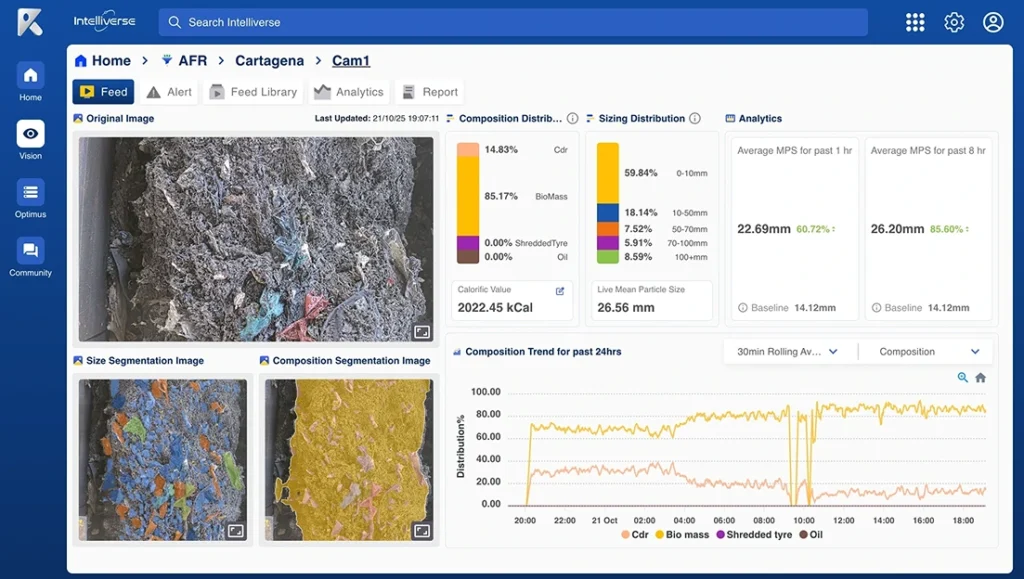
The AFR monitoring system performs 24/7 monitoring of feed belts using advanced AI and vision-based analytics. It automatically detects and classifies various fuel types while analyzing key physical attributes such as color, texture, and particle size to achieve effective fuel mix optimization for cement kilns. This real-time visibility minimizes feed inconsistencies and enables operators to optimize fuel utilization with greater precision, enhancing combustion stability, energy efficiency, and overall kiln performance.
AI-based Calorific Value Measurement accurately calculates and adjusts the real-time calorific value in cement kilns through continuous RDF Calorific Value Analysis. The AFR monitoring system evaluates key fuel parameters such as texture, color, and moisture content using advanced visual video feeds and AI analytics. This intelligent automation eliminates delays associated with traditional laboratory-based testing methods and provides operators with real-time, data-driven control over the combustion process. By delivering continuous and precise insights, the system helps maintain a higher Thermal Substitution Rate (TSR) — ensuring efficient fuel utilization, stable kiln operation, and optimized overall energy performance.
Once the Calorific Value Monitoring System detects a change in calorific value, it communicates directly with the kiln control system (DCS/PLC) to adjust fuel feed rates and air supply automatically. This helps maintain a stable flame temperature, consistent combustion, and optimal heat transfer — all critical for maintaining clinker quality and fuel efficiency.
Waste-Derived Fuel Monitoring systems analyze the moisture content in alternative fuels in real time using advanced AI-based analytics. By accurately detecting moisture variations, the AFR system helps maintain a consistent net calorific value (NCV) and ensures optimal combustion efficiency. It also generates historical moisture trend reports to identify recurring inefficiencies, enabling plants to improve fuel preparation processes and achieve more stable kiln performance.
AI-based fuel monitoring systems continuously scan AFR feed belts to detect non-combustible materials like stones, glass, metals, and oversized particles. These impurities can disrupt combustion and damage equipment. Proactive detection ensures stable kiln operation, enhances process reliability, and supports Thermal Substitution Rate Optimization by maintaining a clean and consistent fuel feed.
The AI-based Alternative Fuel Monitoring System sends instant, automated alerts and actionable recommendations when it detects anomalies—such as inconsistent feed rates, irregular combustion patterns, elevated moisture content, or thermal deviations—enabling operators to respond immediately and prevent unplanned downtime, reduce process disruptions, and improve overall operational efficiency.
AI-based monitoring systems record and store historical video feeds for post-event analysis, allowing engineers to review critical operations, detect behavioral trends, and identify the root causes of process disturbances. Comprehensive reporting tools summarize recurring issues and performance patterns, supporting data-driven decision-making, continuous improvement, and fuel optimization across cement plants.
Accurate calorific value estimation is no longer just a quality control measure — it is a strategic necessity for maintaining kiln stability, optimizing energy utilization, and achieving sustainable cement production. As cement plants increasingly adopt Alternative Fuels and Raw Materials (AFR) such as RDF, biomass, and waste-derived fuels, real-time AI-based monitoring systems ensure consistency, precision, and process reliability that manual methods cannot match.
By integrating AI-powered calorific value measurement and Alternative Fuel Monitoring Systems, manufacturers can achieve higher Thermal Substitution Rates (TSR), reduce fuel costs, and minimize carbon emissions — all while maintaining clinker quality and production efficiency. This digital transformation represents the future of the cement industry: one that is intelligent, efficient, and committed to sustainability.
Insights and perspectives from Ripik.ai's thought leaders
Fire and smoke incidents in the Raw Material Handling System (RMHS) represent a significant operational...
In modern steel plants, operational stability depends not only on equipment performance and automation...
Hotspot Monitoring of Electrical Equipments has emerged as the most effective technique to detect overheating,...
Discover how AI and vision analytics reduce process variability in manufacturing — cutting energy costs...
Learn how AI-driven stabilization reduces blast furnace variability by up to 70%, cuts coke rates by...
Accurate molten metal level measurement is vital for maintaining stability, safety, and quality in modern...
A powerful suite of intelligent agents working in sync to transform manufacturing with speed, precision, and autonomy.