


Zero Downtime, High Yield, AI-Driven Vision
Zero Downtime, High Yield, AI-Driven Vision
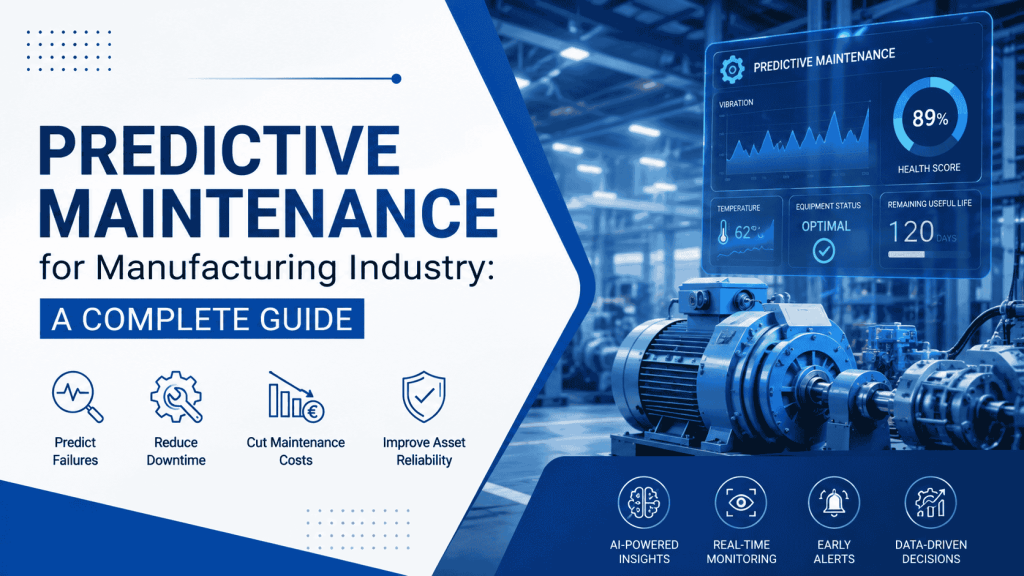
Predictive maintenance is a proactive maintenance strategy that uses real-time equipment data, Artificial Intelligence (AI), Industrial Internet of Things (IIoT), computer vision, and advanced analytics to predict equipment failures before they occur. Instead of relying on fixed maintenance schedules or waiting for machinery to break down, manufacturers can continuously monitor the health of critical assets, detect early warning signs, and schedule maintenance only when it is needed. This approach helps reduce unplanned downtime, lower maintenance costs, improve equipment reliability, and increase overall production efficiency across manufacturing operations.
As manufacturers embrace Industry 5.0 and smart factory initiatives, predictive maintenance has become a key driver of operational excellence. It is widely used to monitor pumps, conveyors, compressors, kilns, furnaces, and other production equipment in industries such as steel, cement, automotive, mining, food processing, chemicals, and the oil and gas industry. In this guide, you'll learn what predictive maintenance is, how it works, how it compares with preventive maintenance, the role of AI and computer vision, its key applications and benefits, implementation best practices, and real-world examples that demonstrate its impact on modern manufacturing.
Predictive maintenance (PdM) is a condition-based maintenance strategy that forecasts equipment failures by continuously assessing the health and performance of industrial assets. Rather than relying on predefined maintenance schedules or reacting to unexpected equipment failures, predictive maintenance relies on continuous data collection and analysis to evaluate operational trends and determine the optimal time for maintenance team. This enables manufacturers to detect degradation at an early stage, plan interventions proactively, and prevent failures before they disrupt production.
Unlike traditional maintenance strategies, predictive maintenance aligns maintenance activities with the actual condition of the equipment, ensuring that components are serviced only when necessary. This not only improves asset reliability and extends equipment lifespan but also optimizes maintenance planning, reduces operational risk, and enhances overall plant performance; to do this accurately, organizations should set baselines for asset performance metrics so changes in equipment condition can be measured over time. As a result, predictive maintenance has become a foundational capability for modern manufacturing, helping organizations transition from time-based maintenance to data-driven asset management.
Selecting the right maintenance strategy is essential for maximizing equipment reliability, minimizing downtime, and optimizing maintenance costs. Manufacturers typically use four primary maintenance approaches, each with a different objective and level of technological maturity.
Also known as run-to-failure maintenance, reactive maintenance involves repairing or replacing equipment only after it has failed. While this approach requires minimal planning and lower upfront costs, it often leads to unplanned downtime, higher repair expenses, production losses, and potential safety risks. It is generally suitable only for non-critical or low-cost assets.
Preventive maintenance is a time-based or usage-based strategy in which equipment is serviced at predetermined intervals, regardless of its actual condition. Routine inspections, lubrication, calibration, and work on key equipment components help reduce failures, but because tasks are scheduled by time or usage, they may not always prevent equipment failure at the right moment. However, fixed maintenance schedules can result in unnecessary servicing or fail to detect issues that develop between maintenance cycles.
Predictive maintenance is a condition-based approach that monitors equipment health to determine when maintenance is actually required. By analyzing sensor data and building predictive models, it enables manufacturers to schedule maintenance based on actual wear and changing equipment performance, a predictive maintenance approach that is especially effective for reducing equipment failures, minimizing unplanned downtime, extending asset life, and optimizing maintenance resources by servicing equipment only when necessary.
Prescriptive maintenance builds on predictive maintenance by not only identifying potential failures but also recommending the most effective corrective actions. Using advanced analytics, artificial intelligence, and optimization algorithms, it evaluates multiple maintenance scenarios and suggests the best course of action based on factors such as equipment condition, production schedules, resource availability, and operational risk. This represents the most advanced stage of intelligent maintenance and supports data-driven decision-making.
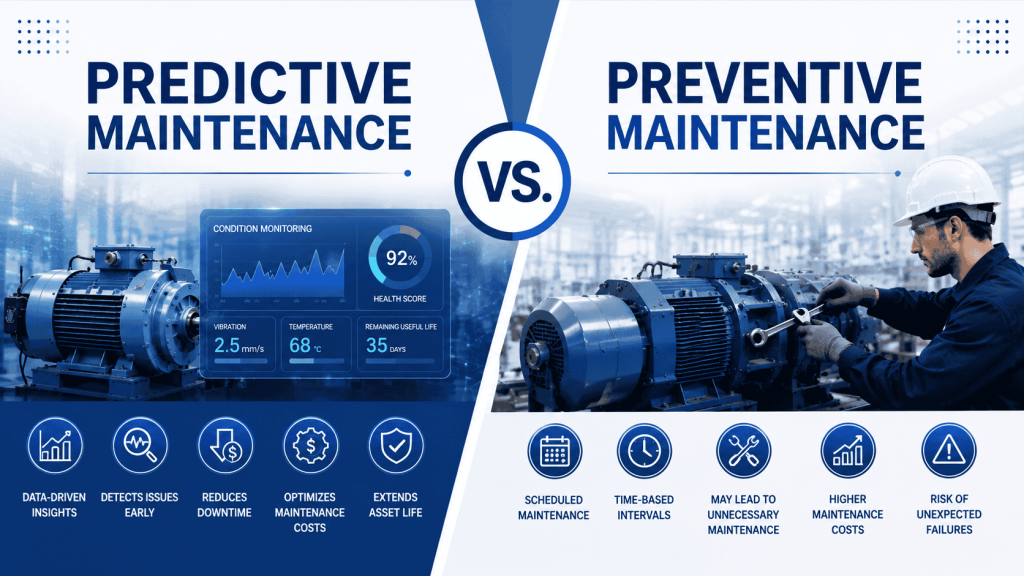
Although both predictive maintenance and preventive maintenance aim at reducing equipment failures and improve operational reliability, they differ fundamentally in their approach. Preventive maintenance is performed at predetermined intervals based on time, operating hours, or manufacturer recommendations, regardless of the equipment's actual condition. While this helps reduce the likelihood of unexpected failures, it can result in unnecessary maintenance and increased operational costs.
Predictive maintenance reduces overall maintenance costs and helps reduce maintenance costs by avoiding unnecessary servicing and emergency work.
Predictive maintenance, on the other hand, is driven by the actual condition of the equipment. It continuously evaluates asset performance to identify early fault detection and determines the optimal time for maintenance. This condition-based approach allows manufacturers to perform maintenance only when it is required, reducing downtime, optimizing maintenance resources, extending asset life, and improving overall production efficiency. As manufacturing operations become increasingly data-driven, predictive maintenance is emerging as the preferred strategy for maximizing equipment reliability and operational performance.
Predictive maintenance works by continuously monitoring the health of industrial equipment and analyzing operational data to identify early signs of degradation or abnormal behavior. Instead of relying on routine maintenance schedules, it evaluates the actual condition of assets to determine when maintenance is required. This allows manufacturers to detect potential failures well in advance, schedule maintenance during planned production windows, and avoid costly unplanned downtime.
The process combines real-time data collection, intelligent analytics, and automated decision-making to transform raw machine data into actionable maintenance insights, with predictive maintenance software turning that information into actionable insights. In practice, how predictive maintenance works also depends on overcoming challenges such as high initial investment and data quality concerns. Below is a typical predictive maintenance workflow:
Data Collection: Predictive maintenance begins by collecting data from multiple sources, including Industrial IoT (IIoT) sensors, PLCs, SCADA and DCS systems, condition monitoring devices, maintenance logs, ERP/CMMS platforms, and historical equipment records. Predictive maintenance programs depend on high-quality inputs from these sources, and organizations should establish performance baselines for key asset metrics. By combining real-time operational data analysis with historical asset information, manufacturers gain a comprehensive view of equipment health, enabling accurate condition monitoring and early fault detection.
Data Processing & Integration: After data is collected, it is cleaned, standardized, and integrated into a centralized platform. Real-time sensor data is combined with historical maintenance records, production data, and equipment information to create a unified view of asset health, while data analysis and data quality issues directly affect prediction accuracy. This structured data serves as the foundation for accurate AI analysis and reliable failure prediction.
Condition Monitoring: The integrated data is continuously monitored to track the health and performance of critical assets, including rotating machinery and electrical systems. By analyzing parameters such as vibration, temperature, pressure, current, and energy consumption, and using vibration analysis for motors, pumps, and gearboxes, the system detects abnormal operating conditions and identifies early signs of equipment degradation before they develop into failures.
Failure Prediction: AI and machine learning analyze equipment data to detect anomalies, identify abnormal operating patterns, and predict potential failures before they occur. In practice, machine learning algorithms process sensor streams against historical baselines and failure patterns to create predictive models for early fault detection. By estimating the likelihood of failure and the remaining useful life (RUL) of critical components, the system enables maintenance teams to take proactive action and prevent unplanned downtime.
Maintenance Scheduling: When a potential issue is identified, the system automatically generates maintenance recommendations or alerts. Maintenance activities can then be scheduled during planned shutdowns, ensuring minimal disruption to production while improving asset reliability and optimizing maintenance resources.
Predictive maintenance uses real-time data collected from sensors, cameras, machines, and digital systems, combined with AI and advanced analytics, to identify early signs of equipment deterioration before they lead to unexpected failures. In manufacturing, where a single equipment breakdown can disrupt production and increase maintenance costs, predictive maintenance helps teams move from reactive repairs to proactive intervention.
Some of the most widely used predictive maintenance techniques for manufacturing include:
Vibration analysis monitors changes in the vibration patterns of industrial equipment to detect early signs of mechanical problems. It is particularly useful for rotating machinery such as motors, pumps, compressors, fans, gearboxes, and turbines. Changes in vibration frequency, amplitude, or overall pattern indicate issues such as imbalance, misalignment, mechanical looseness, bearing wear, or gear damage. By identifying these abnormalities early, maintenance teams can investigate and address developing problems before they result in equipment failure or costly downtime.
Infrared thermography uses thermal cameras or infrared sensors to monitor equipment temperature and identify abnormal heat patterns. Since many mechanical and electrical problems generate excess heat, thermal imaging help detect issues such as overheating motors, electrical hotspots, bearing problems, overloaded components, and inadequate cooling. By identifying temperature anomalies before they escalate, allowing manufacturers schedule corrective maintenance and reduce the risk of unexpected equipment failures.
Acoustic and ultrasonic analysis monitors the sound and high-frequency signals generated by industrial equipment to identify abnormal operating conditions. Specialized acoustic or ultrasonic sensors detect changes associated with bearing deterioration, inadequate lubrication, compressed-air leaks, mechanical friction, valve problems, and other equipment abnormalities. Unlike vibration analysis, which focuses primarily on physical movement, acoustic analysis focuses on changes in sound and acoustic energy, making it a useful complementary technique for condition monitoring.
Motor Current Signature Analysis (MCSA) analyzes the electrical current and voltage patterns of motors to identify abnormalities that may indicate developing mechanical or electrical faults. Changes in the motor's electrical signature can help detect issues such as rotor and stator faults, voltage imbalance, mechanical overload, and certain bearing-related problems. Because current measurements can often be collected without physically accessing the motor, MCSA can be useful for monitoring equipment that is difficult or hazardous to reach.
Modern manufacturers are moving beyond traditional predictive maintenance by combining operational data with Computer Vision, artificial intelligence (AI), and IIoT as advanced technologies that strengthen predictive maintenance solutions and deliver a more comprehensive understanding of equipment health. While sensors and industrial control systems such as PLCs, SCADA, and DCS provide valuable insights into machine performance, they cannot detect visible issues like cracks, corrosion, leaks, smoke, material buildup, or component wear. Computer Vision bridges this gap by analyzing live video feeds from existing CCTV and industrial cameras, while AI correlates these visual insights with real-time operational and historical data to identify anomalies, predict failures, and recommend timely maintenance actions. This data-driven approach enables earlier fault detection, improves prediction accuracy, reduces false alarms, and helps manufacturers minimize unplanned downtime, maximize equipment reliability, and improve asset availability while supporting operational efficiency.
Artificial Intelligence is the driving force behind modern predictive maintenance. AI processes vast amounts of historical and real-time equipment data to identify hidden patterns, predict potential failures, and turn equipment data into recommendations for predictive maintenance tasks. By continuously learning from new operational data, AI improves prediction accuracy and enables proactive maintenance planning.
Machine Learning algorithms process real-time sensor inputs and historical baselines to detect anomalies automatically, identify failure patterns, and estimate the Remaining Useful Life (RUL) of critical assets. As models are trained on more maintenance and operational data, improving through analyzing sensor data over time, they become increasingly accurate, helping manufacturers reduce unnecessary maintenance and prevent unexpected breakdowns.
Computer Vision enhances predictive maintenance by enabling continuous visual inspection using existing CCTV cameras, thermal cameras, and industrial imaging systems. AI-powered vision models automatically detect cracks, corrosion, leaks, overheating, smoke, belt misalignment, material buildup, and equipment wear, providing early warnings that traditional sensors may miss.
Digital Twins create virtual replicas of physical assets by combining real-time operational data with simulation models. These digital models allow manufacturers to monitor equipment health, simulate different operating scenarios, predict failures before they occur, and optimize maintenance strategies without disrupting production. Edge computing can support Digital Twins by enabling faster local analysis before data is sent to centralized platforms.

Below are some of the most common predictive maintenance examples in manufacturing, showing how predictive maintenance solutions help organizations reduce unplanned downtime, cut maintenance costs, minimize the need for corrective maintenance, improve equipment reliability, and optimize overall plant performance.
Crusher are the primary part of the cement plant manufacturing, computer vision and AI platform continuously monitor the conveyor belt material using live video feed size, shape, and flow of material before it enters the crusher. The platform automatically detect oversized rocks, tramp metal, large boulders, and other foreign objects that could damage the crusher or cause blockages. When a potential risk is identified, the system generates real-time alerts or can trigger automated actions, such as stopping or slowing the conveyor belt, allowing operators to remove the oversized material before it reaches the crusher.
Conveyor belts are the lifeline of all manufacturing industries. AI platforms continuously monitor conveyor belt operations in real time, instantly detecting belt misalignment, tears, roller failures, belt slippage, material spillage, blockages, bearing failures, excessive wear, and overload conditions. The conveyor belt system identifies anomalies that could lead to equipment failure or production disruptions before they result in sudden downtime, enabling maintenance teams to take corrective action before minor issues escalate into costly breakdowns. This is one of the most common applications of predictive maintenance solutions in manufacturing industries.
Ladle Activity Monitoring enables continuously monitoring of ladle operations by tracking ladles, cranes, and ladle cars in real time, analyzing their movement, positioning, secure hooking, transfer operations, and material handling activities. The system detects abnormal movements, incorrect positioning, unsafe handling practices, operational delays, missed process steps, and inefficient material flow. By generating real-time alerts and actionable insights, the ladle management system helps improve process efficiency, reduce equipment wear, minimize operational risks, and enhance worker safety throughout the steelmaking process.
Continuous monitoring of kiln health by analyzing flame characteristics, kiln shell condition, coating formation, refractory condition, and thermal patterns using industrial and thermal cameras. The system identifies abnormalities such as flame instability, shell hotspots, refractory wear, coating buildup, and uneven heat distribution that may indicate potential equipment failures. By generating real-time alerts and actionable insights, the kiln health monitoring system enables perfect predictive maintenance strategies allowing maintenance teams to optimize kiln performance, prevent unplanned shutdowns, improve energy efficiency, and extend the lifespan of critical kiln components.
Electrical equipments are the most important part of any industries any abnormal temperature rise in transformers, switchgear, motors, electrical panels, substations, and other assets can lead to production losses and high repair cost. The hotspot monitoring system using thermal cameras to detect abnormal temperature and analyzes thermal images in real time to identify hotspots caused by loose connections, overloaded circuits, insulation degradation, or failing components before they lead to failure. By generating instant alerts and actionable insights, the system enables operating teams to address issues proactively, preventing electrical failures, reducing fire risks, minimizing sudden downtime, and improving overall electrical system reliability.
Boiler tube leak detection combines thermal imaging, acoustic monitoring, and AI-powered analytics to identify early signs of tube failure. The system continuously monitors temperature variations, steam leakage patterns, pressure changes, and abnormal sounds associated with leaking tubes. AI distinguishes actual leaks from normal operating conditions and predicts potential failures before they become critical. This enables maintenance teams to perform repairs during planned shutdowns, minimizing equipment damage, improving boiler efficiency, and preventing unexpected plant outages.
Refractory monitoring uses thermal cameras and Computer Vision to continuously inspect refractory linings inside furnaces, kilns, ladles, and boilers. AI analyzes thermal images and visual data to identify hotspots, cracks, erosion, spalling, and uneven wear that indicate lining deterioration. Instead of relying on periodic manual inspections, the system provides continuous monitoring and early alerts, allowing maintenance teams to repair damaged refractory before it causes equipment failure or production loss.

Predictive maintenance helps manufacturers transition from reactive and time-based maintenance to a proactive, data-driven approach. Manufacturing downtime costs industrial manufacturers up to $50 billion annually. By leveraging AI, machine learning, Computer Vision, and real-time equipment monitoring, manufacturers can identify potential failures before they occur, optimize maintenance schedules, and improve overall operational performance.
Reduced Unplanned Downtime: Predictive maintenance detects early signs of equipment degradation, allowing maintenance teams to resolve issues before they lead to unexpected breakdowns. This minimizes production disruptions and improves equipment availability.
Lower Maintenance Costs: Instead of performing maintenance at fixed intervals or after equipment failure, predictive maintenance enables maintenance only when it is needed and can reduce maintenance costs by 18% to 31%. This reduces unnecessary servicing, emergency repairs, spare parts inventory, and labor costs, creating cost savings, while earlier issue detection also helps lower repair costs.
Extended Equipment Lifespan: Continuous monitoring and timely maintenance prevent excessive wear and component damage, helping critical assets operate efficiently for longer and delaying costly equipment replacements.
Improved Asset Reliability: AI-powered analytics continuously assess equipment health and identify abnormal operating conditions, resulting in more reliable machinery, fewer failures, and improved production consistency.
Increased Overall Equipment Effectiveness (OEE): By reducing downtime, improving equipment reliability, and maintaining optimal machine performance, predictive maintenance helps manufacturers improve Overall Equipment Effectiveness (OEE) and maximize production output.
Enhanced Worker Safety: Computer Vision and AI can detect equipment defects, overheating, leaks, smoke, and hazardous operating conditions before they become safety incidents. This reduces risks for maintenance personnel and creates a safer working environment.
Data-Driven Maintenance Decisions: Predictive maintenance platforms combine data from IoT sensors, PLCs, SCADA, DCS, MES, ERP systems, maintenance records, and Computer Vision to provide actionable insights, enabling maintenance teams to prioritize repairs based on asset condition rather than fixed schedules.
Improved Production Efficiency: Well-maintained equipment operates more consistently, reducing process variability, improving product quality, minimizing scrap, and increasing overall manufacturing efficiency.
Optimized Resource Utilization: Predictive insights help manufacturers allocate maintenance personnel, spare parts, and maintenance budgets more effectively by focusing resources on equipment that requires immediate attention.
Support for Industry 4.0 and Smart Manufacturing: Predictive maintenance is a foundational capability of Industry 4.0, enabling connected factories to leverage AI, Computer Vision, Digital Twins, Edge AI, and industrial IoT for intelligent, autonomous, and data-driven operations.
Successfully implementing predictive maintenance requires more than installing sensors or deploying AI. It involves creating a connected ecosystem that integrates equipment data, advanced analytics, and maintenance workflows. Follow these seven steps to build an effective predictive maintenance strategy.
Begin by identifying the equipment that has the greatest impact on production, safety, and operational costs. Prioritize high-value assets such as motors, pumps, compressors, conveyors, kilns, furnaces, turbines, and other machinery where unexpected failures can cause significant downtime, especially assets whose failure can disrupt entire production lines.
Evaluate the data already available across your facility. This may include IoT sensors, PLCs, SCADA and DCS systems, MES, ERP platforms, CMMS, maintenance records, inspection reports, and industrial cameras. Understanding your existing data infrastructure helps determine what additional monitoring capabilities are required. At the selection stage, assess predictive maintenance software and broader predictive maintenance solutions by how well they ingest and contextualize your existing plant data.
Install condition monitoring sensors where necessary to capture parameters from mechanical and electrical systems, such as vibration, temperature, pressure, current, and energy consumption. Complement sensor data with Computer Vision using existing CCTV cameras, thermal cameras, or industrial imaging systems, and use vibration analysis alongside visual inspection to monitor visible equipment defects and rotating-equipment issues such as cracks, leaks, corrosion, smoke, overheating, and material buildup.
Connect all operational data sources into a centralized predictive maintenance platform. Integrate IoT devices, PLCs, SCADA, DCS, MES, ERP, and maintenance management systems to create a unified view of equipment health and enable seamless data exchange across the organization.
Implement AI and machine learning models that use data analysis to build predictive models from real-time and historical equipment data. These models, improving by analyzing sensor data against established baselines, detect anomalies, identify failure patterns, estimate Remaining Useful Life (RUL), and generate predictive maintenance alerts and recommendations that help maintenance teams intervene before failures occur.
Ensure maintenance engineers, operators, and reliability teams understand how to interpret AI insights, respond to predictive alerts, and use dashboards effectively. Establish standardized maintenance workflows so predictive recommendations translate into timely corrective actions.
Track key performance indicators (KPIs) such as equipment availability, unplanned downtime, maintenance costs, Mean Time Between Failures (MTBF), Mean Time to Repair (MTTR), and Overall Equipment Effectiveness (OEE). Continuously refine AI models, update maintenance strategies, and incorporate new operational data to improve prediction accuracy and maximize long-term performance.
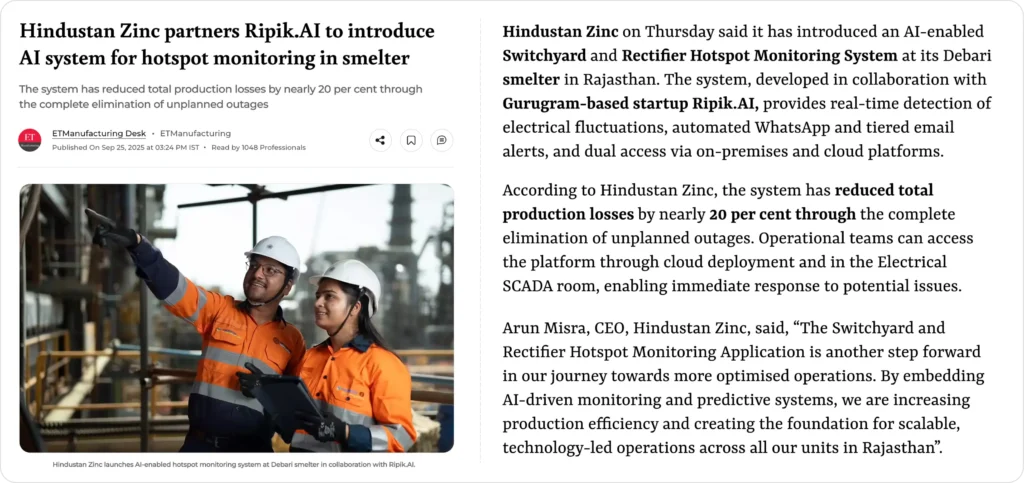
Predictive maintenance is delivering measurable business outcomes across industries by combining AI, Computer Vision, thermal imaging, and real-time analytics to detect equipment degradation before failures occur. Hindustan Zinc has deployed AI-enabled Switchyard and Rectifier Hotspot Monitoring System at its Debari smelter plant in Rajasthan in collaboration Ripik.AI.
According to Hindustan Zinc, the system has reduced total production losses by nearly 20 per cent through the complete elimination of unplanned outages. Arun Misra, CEO, Hindustan Zinc, said, “The Switchyard and Rectifier Hotspot Monitoring Application is another step forward in our journey towards more optimised operations. By embedding AI-driven monitoring and predictive systems, we are increasing production efficiency and creating the foundation for scalable, technology-led operations across all our units in Rajasthan”.
Predictive maintenance has evolved from simple condition monitoring into an intelligent, AI-powered strategy that enables manufacturers to anticipate equipment failures before they occur, and it is also used in fleet operations to monitor vehicle health. By combining data from IoT sensors, industrial control systems, enterprise platforms, and Computer Vision, organizations gain a comprehensive view of asset health and can make faster, data-driven maintenance decisions across industries. This proactive approach reduces unplanned downtime, lowers maintenance costs, extends equipment lifespan, and improves overall operational efficiency.
Insights and perspectives from Ripik.ai's thought leaders

Vision AI in blast furnace operations enables real-time monitoring to identify visual patterns, detect...
Discover practical strategies to enhance plant operations with AI, boosting efficiency and productivity....

Computer Vision for Manufacturing: Applications and Benefits Introduction Manufacturers today face increasing...
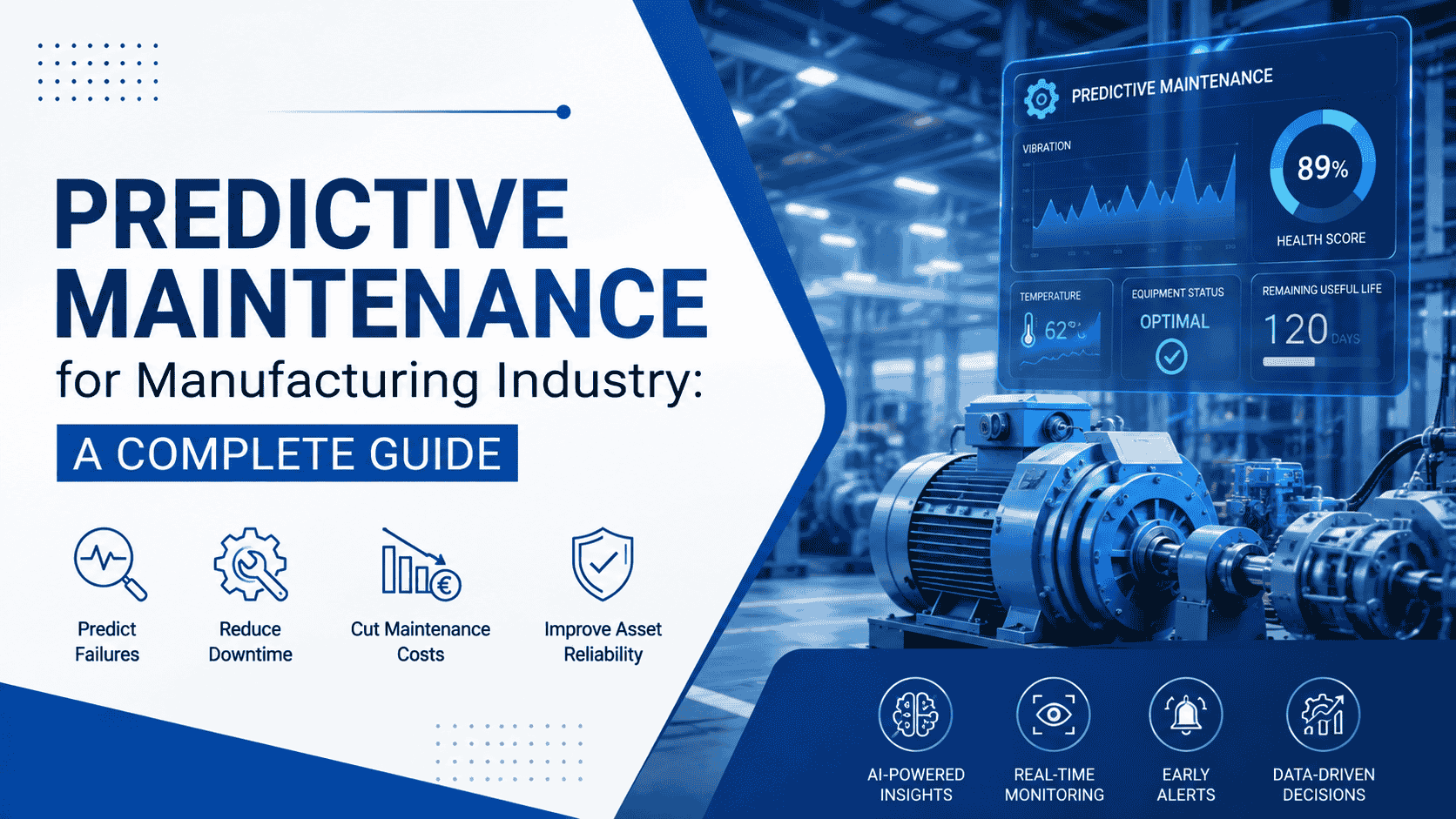
Predictive Maintenance in Manufacturing Industry: A Complete Guide Introduction Predictive maintenance...

Discover how AI in cement manufacturing improves kiln optimization, energy efficiency, predictive maintenance,...
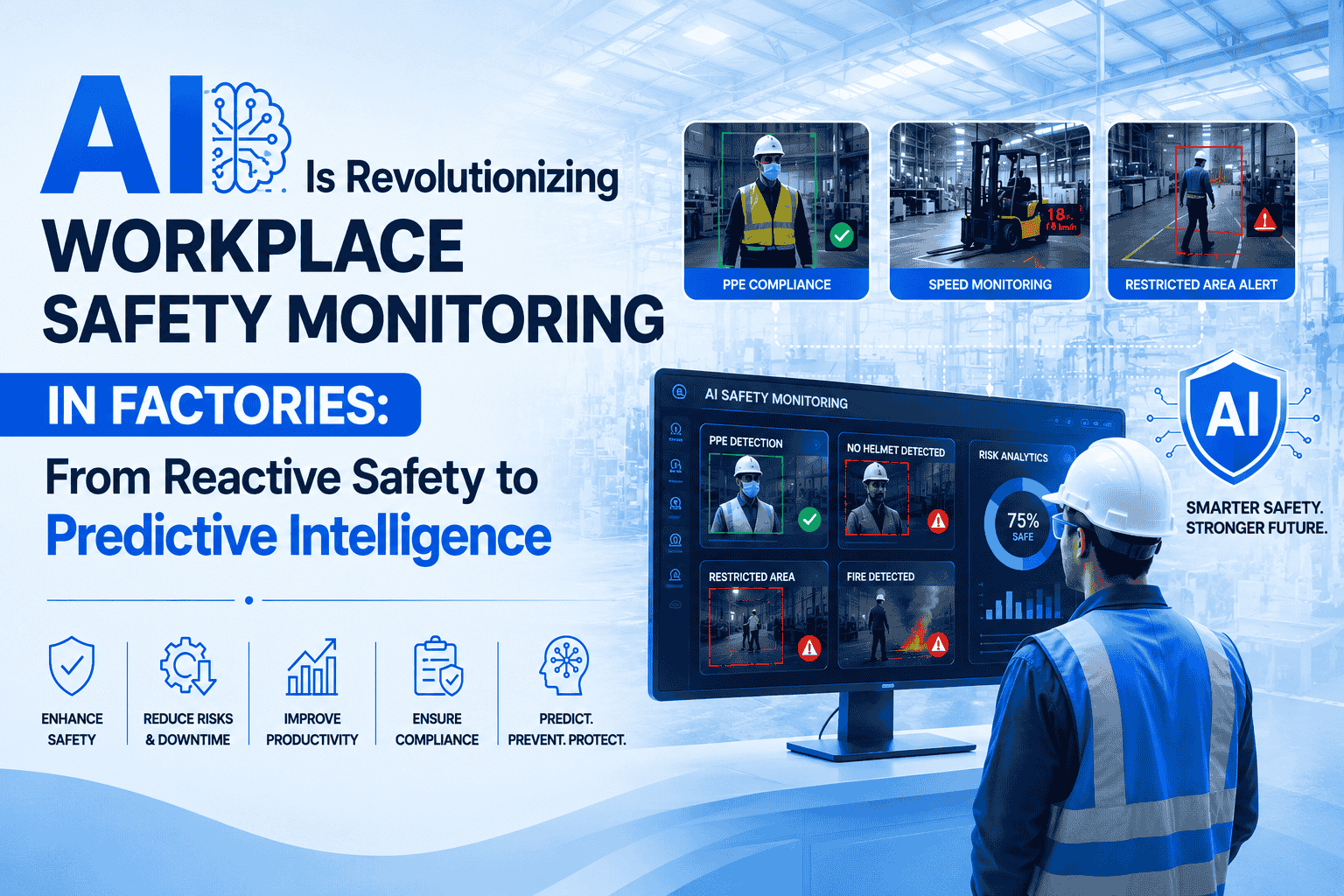
Vision AI unlocks the true value of this existing infrastructure by continuously analyzing live video...
A powerful suite of intelligent agents working in sync to transform manufacturing with speed, precision, and autonomy.