


Zero Downtime, High Yield, AI-Driven Vision
Zero Downtime, High Yield, AI-Driven Vision
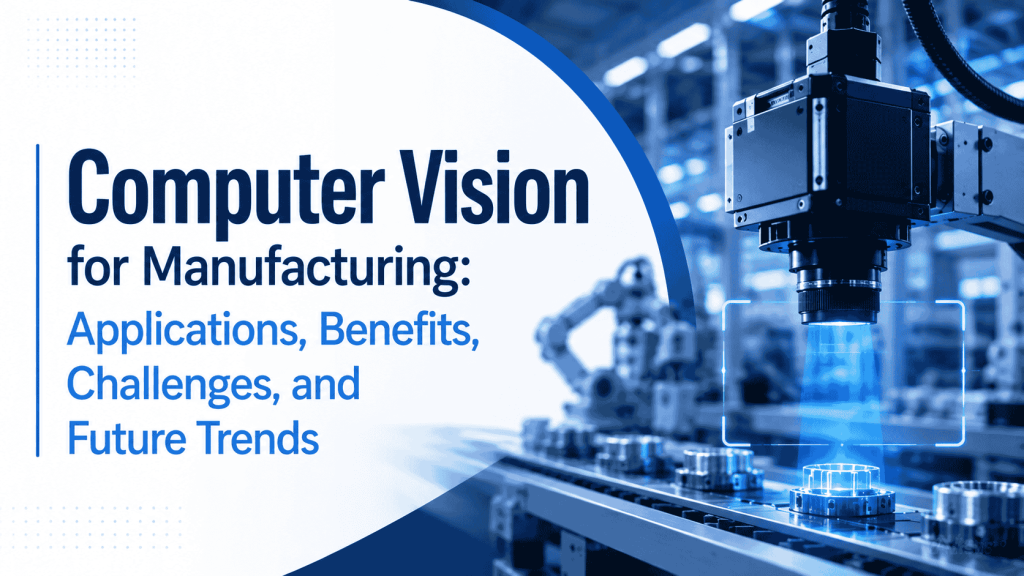
Manufacturers today face increasing pressure to improve product quality, boost productivity, reduce operational costs, and meet sustainability goals, all while navigating labor shortages and with complex production processes. Unlike traditional quality control methods, AI-driven monitoring can scale inspection and decision-making with greater speed, consistency, and accuracy across modern manufacturing environments. As Industry 5.0 accelerates digital transformation, traditional inspection and monitoring methods are proving insufficient to deliver the speed, accuracy, and scalability required in modern manufacturing environments.
Computer vision is emerging as a key enabler of smart manufacturing, serving as a computer vision solution for factory automation that combines AI with visual data to automate inspections, strengthen quality assurance, monitor critical processes in real time, enhance workplace safety, and support predictive maintenance. This guide explores how computer vision is transforming manufacturing, its key industrial applications, business benefits, implementation challenges, and the future trends shaping AI-driven production, including how these gains support improved efficiency and customer satisfaction.
Computer vision is a subfield of artificial intelligence (AI) that enables machines to process, analyze, and interpret visual inputs such as digital images and video streams, using cameras and algorithms to interpret visual data much like humans perceive and understand visual information. Acting as an automated pair of eyes, computer vision systems use industrial cameras to capture visual data and apply image processing, machine learning, and deep learning algorithms to identify objects, detect defects, recognize patterns, measure dimensions, and generate actionable insights for real-time automated decision-making. In manufacturing contexts, this capability is also described as ai vision.
Computer vision in manufacturing follows a structured workflow that transforms visual data into actionable insights for real-time monitoring and automated decision-making.
Image Acquisition: Industrial cameras, thermal cameras, or 3D vision systems capture continuous images or video streams from production lines, equipment, or work areas, and may use high resolution images when fine-detail inspection is required.
Image Preprocessing: The captured images are enhanced using image processing techniques such as noise reduction, contrast adjustment, resizing, and normalization to improve analysis accuracy.
AI-Based Analysis: Computer vision models powered by deep learning analyze the processed images to perform object detection, identify defects, classify products, recognize patterns, measure dimensions, segment regions of interest, and detect anomalies in real time.
Inference and Decision-Making: Based on the AI model’s predictions, the system generates real-time insights or triggers predefined actions, such as rejecting defective products, raising alerts, adjusting process parameters, or notifying operators.
System Integration: The results are integrated with industrial control systems such as PLCs, SCADA, MES, or ERP platforms, enabling automated process control, production monitoring, quality management, and predictive maintenance.
By continuously analyzing visual data throughout the production process, computer vision can also be deployed in the early stages of the manufacturing process to catch issues sooner, optimize processes, and improve performance across broader industrial processes.
Although computer vision and traditional machine vision both automate visual inspection, they differ in how they analyze data. Traditional machine vision relies on predefined rules and algorithms for specific inspection tasks, while computer vision uses AI and deep learning to interpret complex visual data, adapt to changing conditions, and make more intelligent decisions.
Traditional machine vision systems are highly effective in controlled environments where products, lighting conditions, and inspection criteria remain consistent. These systems use fixed rules, thresholds, and pattern-matching techniques to detect known defects or verify product attributes, making them especially effective for structured, repetitive tasks. However, their performance can decline when faced with product variations, changing environmental conditions, or previously unseen defects, often requiring manual reprogramming.
Computer vision systems, on the other hand, uses deep learning models trained on large datasets to recognize patterns, detect anomalies, classify objects, and adapt to changing manufacturing conditions. Instead of relying solely on predefined rules, AI-powered computer vision models continuously learns from data, enabling it to identify both known and unknown defects with greater accuracy, including subtle defects in variable environments. This also reduces reliance on human inspectors when production conditions, product types, or visual signals change. This makes it particularly well suited for modern manufacturing environments, where production lines handle diverse products, dynamic processes, and large volumes of visual data.
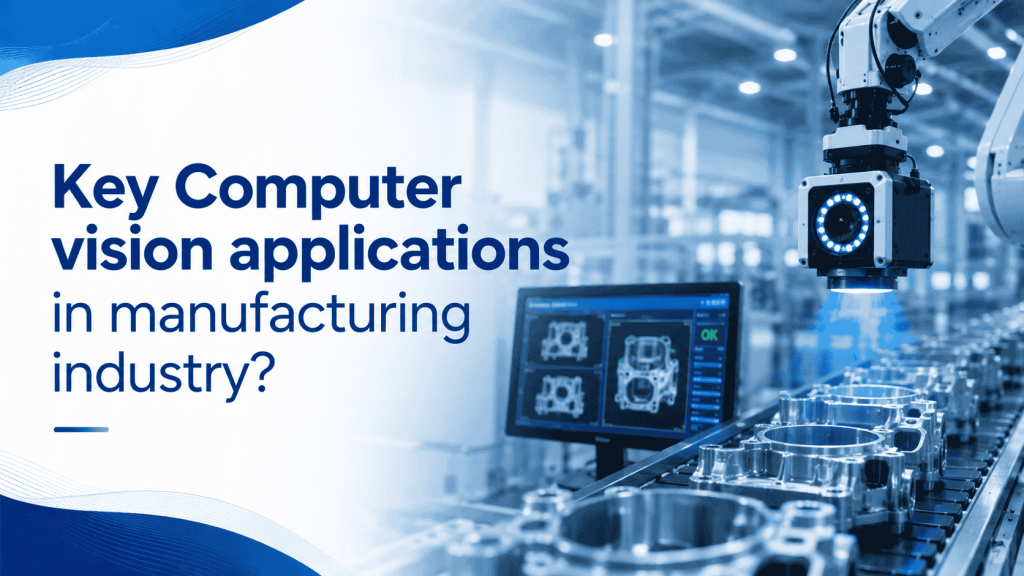
Computer vision helps transform manufacturing by enabling AI-powered automation, real-time monitoring, and intelligent decision-making across production processes, with key applications spanning quality inspection, defect detection, predictive maintenance, worker safety monitoring, OCR, robotic guidance, process monitoring, inventory management, and particle size analysis. These systems run across assembly lines and broader industrial operations, helping manufacturing companies improve product quality, increase productivity, reduce downtime, minimize waste, and focus on enhancing efficiency across production and automation workflows. By converting visual data into actionable insights, it enables faster, more accurate, and data-driven manufacturing operations.
Computer vision systems enhance quality control in manufacturing by using AI-powered cameras and deep learning models to inspect products in real time with exceptional speed and consistency. Unlike manual inspections, which are prone to fatigue and human error, computer vision accurately detects surface defects, cracks, scratches, dimensional deviations, missing components, color variations, and assembly errors. Modern machine vision systems can inspect hundreds to thousands of products per minute, making them ideal for high-speed production lines. By inspecting 100% of products instead of relying on random sampling, manufacturers can improve defect detection, reduce scrap and rework, increase first-pass yield, ensure compliance with quality standards, and deliver consistently high-quality products while lowering overall production costs.
Computer vision enables process optimization in manufacturing by continuously monitoring production lines, equipment, and process parameters in real time to identify inefficiencies, bottlenecks, and process deviations before they impact production. Using AI-powered cameras and deep learning, manufacturers can optimize machine settings, improve Overall Equipment Effectiveness (OEE), stabilize production processes, and reduce variability. In advanced manufacturing facilities, AI-driven process optimization has demonstrated up to a 5% reduction in energy consumption by optimizing process parameters in real time. Computer vision also enables closed-loop process control by automatically detecting deviations and providing instant feedback for corrective actions, resulting in higher productivity, improved product quality, reduced waste, and more efficient manufacturing operations.
Defect detection with modern computer vision systems goes beyond identifying whether a product passes or fails inspection. It enables manufacturers to locate, classify, and measure defects based on their size, shape, severity, and position, supporting automated inspection for defect classification and providing detailed insights into product quality. Computer vision systems identifies a wide range of manufacturing defects, including micro-cracks, scratches, dents, porosity, weld discontinuities, coating defects, edge chipping, contamination, dimensional deviations, missing components, and assembly inconsistencies, and can identify subtle defects that manual reviews often miss. The inspection data helps manufacturers trace recurring defects to specific machines, materials, or process conditions, enabling faster root cause analysis and continuous process improvement. In an industrial deployment, an AI-powered vision inspection system detected 40% more defects than manual inspection, demonstrating the effectiveness of automated visual inspection in improving defect detection. This also strengthens quality assurance by improving consistency over traditional quality control methods.
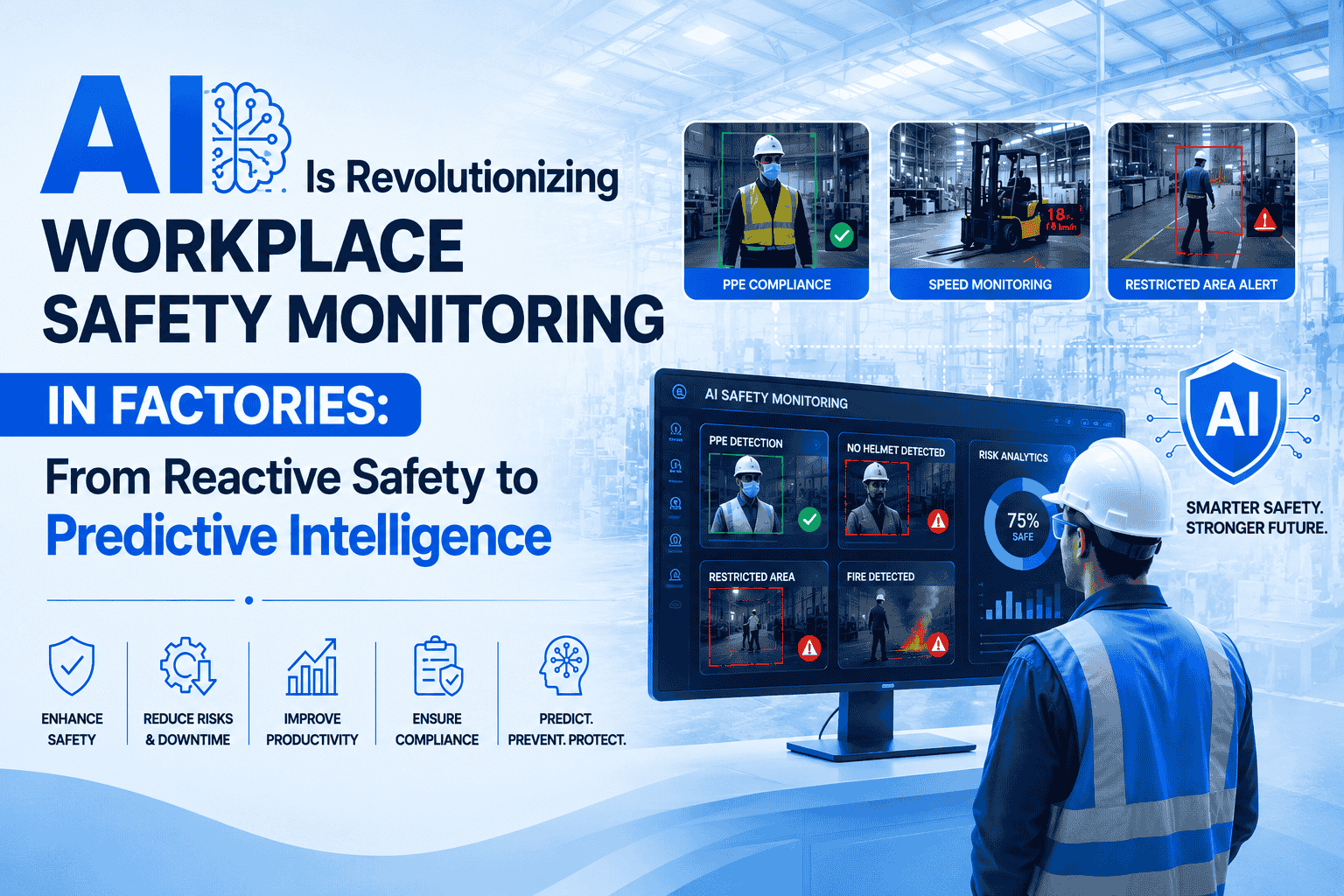
Workplace safety requires continuous visibility into worker activities, equipment, and hazardous zones to prevent incidents before they occur. Computer vision applications enables manufacturers to monitor personal protective equipment compliance, detect restricted-area intrusions, identify unsafe worker behaviors, monitor machine–human interactions, and recognize hazards such as fire, smoke, liquid spills, blocked emergency exits, and unattended objects in real time. It also verifies adherence to standard operating procedures (SOPs) and generates instant alerts when safety violations or hazardous conditions are detected, enabling faster corrective actions. By transforming existing CCTV infrastructure into an intelligent safety monitoring system, manufacturers can shift from reactive incident reporting to proactive risk prevention, improving workplace safety, regulatory compliance, and operational continuity.
Computer vision in manufacturing enables equipment monitoring by providing continuous visual intelligence into the operating condition of industrial assets. Computer vision systems analyze live video feeds to monitor multiple assets simultaneously and detect early signs of equipment degradation. They continuously monitor oil and fluid leaks, excessive smoke, abnormal vibrations, thermal hotspots, cracks, tears, structural deformation, belt misalignment, roller wear, loose or missing fasteners, material blockages, foreign object intrusion (FOI), excessive dust accumulation, and other visual indicators of equipment deterioration. The technology also monitors equipment operating states, material flow, machine-to-machine interactions, conveyor loading, rotating component behavior, and process stability to identify abnormal operating conditions before failures occur. These real-time insights enable predictive maintenance by identifying potential failures before they lead to equipment breakdowns. By enabling early fault detection and condition-based maintenance, computer vision reduces unplanned downtime, improves Overall Equipment Effectiveness (OEE), extends asset life, lowers maintenance costs, and increases equipment reliability and plant availability.
Inventory management in manufacturing extends beyond counting finished products—it involves tracking raw materials, work-in-progress (WIP), stockpiles, spare parts, and finished goods throughout the production lifecycle. Computer vision in manufacturing provides continuous visibility across each inventory stage by monitoring bulk stockpiles for accurate volume estimation, verifying material movement between storage and production, counting items on conveyors and warehouse racks, and validating pallet, package, and finished goods inventory before dispatch. It also detects misplaced materials, inventory discrepancies, unauthorized stock movement, and low-stock conditions in real time, improving inventory accuracy and traceability. By connecting visual inventory data with warehouse and ERP systems, manufacturers gain a real-time view of inventory levels, enabling better procurement planning, optimized storage utilization, reduced carrying costs, and uninterrupted production.
Computer vision in manufacturing optimizes supply chains by improving the visibility and flow of materials across the entire production ecosystem. It monitors inbound raw material deliveries, verifies material quality before production, tracks work-in-progress (WIP) movement between manufacturing stages, validates loading and unloading operations, and confirms shipment accuracy before dispatch. By continuously monitoring material flow, computer vision helps identify production bottlenecks, conveyor congestion, idle assets, delayed material replenishment, and logistics disruptions that impact throughput. These real-time operational insights enable manufacturers to synchronize production with material availability, improve supplier coordination, reduce lead times, increase on-time deliveries, and build a more responsive and resilient supply chain.
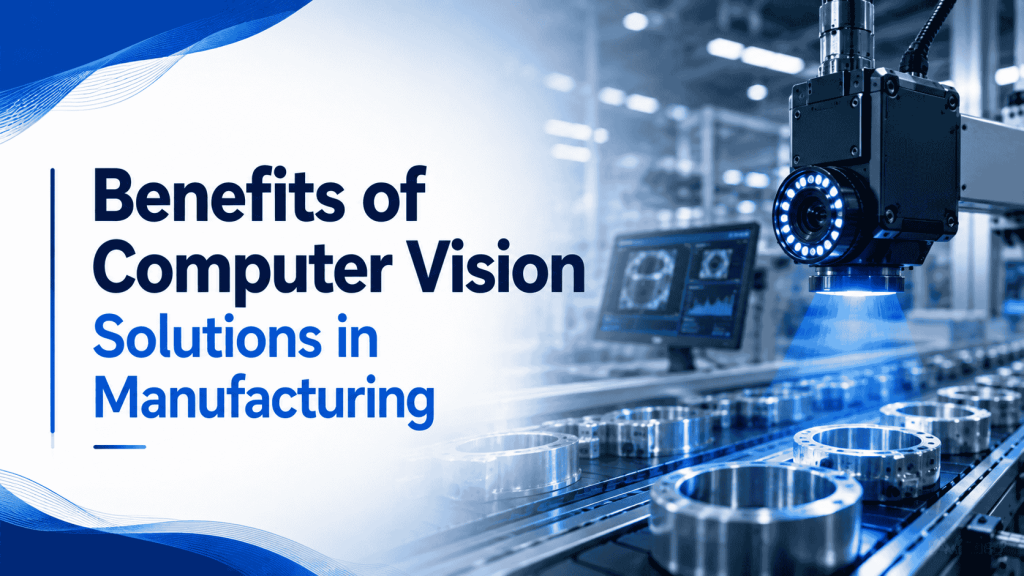
Higher Productivity: Computer vision automates repetitive inspection, monitoring, and measurement tasks, enabling continuous 24/7 operations with minimal human intervention. This helps manufacturers increase throughput, optimize production cycles, and improve overall equipment efficiency while implementing computer vision for broader factory automation, including supporting cobots in tasks like welding and machine tending. A practical proof point is that Universal Robots grew its welding channel application by over 80% in 2022, and in textile production, robots can assemble one T-shirt every 22 seconds.
Improved Product Quality: AI-powered visual inspection detects defects, dimensional deviations, surface imperfections, assembly errors, and damages on sealed packages in real time. Early defect detection ensures consistent product quality, reduces customer complaints, and improves first-pass yield; because companies spend 10-40% of retail price on packaging, reducing packaging errors also improves customer service.
Better Workplace Safety: Computer vision continuously monitors hazardous areas, PPE compliance, restricted zones, and unsafe worker behaviors. Real-time alerts help prevent accidents, ensure regulatory compliance, and create a safer working environment.
Reduced Downtime: By continuously monitoring equipment conditions, conveyor systems, furnaces, and production lines, computer vision identifies abnormalities before they lead to failures. Early detection enables predictive maintenance and minimizes unplanned downtime.
Lower Operational Costs: Automating inspections and process monitoring reduces manual labor, minimizes rework, lowers maintenance expenses, and optimizes resource utilization, resulting in significant reductions in overall operating costs.
Reduced Material Waste: Real-time process monitoring helps detect process deviations, incorrect material sizing, product defects, and quality inconsistencies early. This prevents defective production, reduces scrap, and maximizes raw material utilization.
Energy Savings: Computer vision provides continuous visibility into production processes, enabling operators to optimize furnace operations, combustion efficiency, equipment loading, and process parameters. Improved process control leads to lower energy consumption and reduced utility costs.
Faster Decision-Making: Computer vision transforms live video into actionable insights through AI-powered analytics, dashboards, and instant alerts. Operators and plant managers can identify issues immediately, respond faster, and make data-driven decisions that improve operational performance.
Computer vision is rapidly becoming a foundational technology for modern manufacturing, helping companies optimize critical processes across the factory lifecycle as factories monitor processes, inspect products, manage inventory, maintain equipment, and ensure workplace safety. By converting visual data into real-time operational intelligence, it helps manufacturers improve productivity, enhance product quality, strengthen worker safety, optimize maintenance through predictive insights, and make faster, data-driven decisions across the production lifecycle. As manufacturing continues to embrace Industry 4.0 and smart factory initiatives, organizations that adopt AI-powered computer vision today will be better positioned to build intelligent, autonomous, and resilient manufacturing operations for the future, while also supporting global sustainability goals through lower waste and better energy use.
Insights and perspectives from Ripik.ai's thought leaders
Vision AI in blast furnace operations enables real-time monitoring to identify visual patterns, detect...
Discover practical strategies to enhance plant operations with AI, boosting efficiency and productivity....
Computer Vision for Manufacturing: Applications and Benefits Introduction Manufacturers today face increasing...
Predictive Maintenance in Manufacturing Industry: A Complete Guide Introduction Predictive maintenance...
Discover how AI in cement manufacturing improves kiln optimization, energy efficiency, predictive maintenance,...
Vision AI unlocks the true value of this existing infrastructure by continuously analyzing live video...
A powerful suite of intelligent agents working in sync to transform manufacturing with speed, precision, and autonomy.