Zero Downtime, High Yield, AI-Driven Vision
In commodity manufacturing, every dollar per tonne counts. Yet across the metals industry, bottom-quartile plants consume up to 56% more energy per tonne than top-quartile producers. At a production scale of 500 KTPA, this gap translates to $30–45 million per year in excess cost. The root cause is not outdated equipment or inferior raw materials — it is process variability.
Process variability is the silent profit killer in continuous manufacturing environments such as copper smelters, zinc refineries, and steel plants. While Six Sigma and lean manufacturing have made strides in reducing waste, a new generation of AI-powered tools — particularly vision AI and machine learning — is enabling manufacturers to detect, diagnose, and eliminate variability at a speed and scale that was previously impossible.
This blog explores how AI reduces variability across the manufacturing value chain, drawing from real-world deployments across some of the largest metals producers globally.
Process variability refers to unplanned deviations in key operational parameters — temperature, chemical dosage, material composition, equipment condition, and throughput rates. Even small deviations, when compounded across thousands of production cycles, lead to:
Industry data reveals a stark contrast between top and bottom performers. Top-quartile producers maintain a coefficient of variation (CoV) of just 3% in energy consumption, while bottom-quartile producers see CoV values of 19% — a 6x gap. The differentiator is not the equipment installed on the shopfloor. It is the consistency and stability of the process itself.
| Quartile | GJ / Tonne Cathode Copper | CoV of Energy Consumption (%) |
|---|---|---|
| Q1 (Top) | 11 | 3% |
| Q2 | 13 | 7% |
| Q3 | 15 | 12% |
| Q4 (Bottom) | 18 | 19% |
At 500 KTPA capacity, the energy gap between Q1 and Q4 alone represents $30–45 million per year in excess cost — a margin that determines whether a plant is profitable or bleeding cash.
Not all variability is random. Analysis of process deviations across industrial operations reveals three primary root causes:
The critical insight is that almost half of all process variability is mitigable. The key lies in early detection and alerting — catching deviations before they cascade into costly disruptions.
Traditional process monitoring relies on periodic manual inspections, operator judgment, and threshold-based alarms from SCADA systems. These approaches suffer from blind spots — operators fatigue, shifts change, and sensors can only monitor what they are positioned to capture.
AI-powered vision platforms fundamentally change this equation by deploying cameras paired with intelligent machine learning layers to create what can be described as “infinite pairs of automated eyes.” This approach enables 24/7 variability detection and alerting across three critical dimensions:
Unlike sensor-based systems that monitor a limited set of parameters, vision AI captures the full visual context of the production environment — detecting anomalies that no sensor was designed to measure.
The strongest argument for AI in variability reduction comes from deployed results. Across 50+ deployments in the metals industry, AI-powered vision systems have delivered over USD 20 million in annual savings. Here are three illustrative examples:
In copper and zinc smelting operations, electrical hotspots in switchyards and cellhouses are a leading cause of unplanned shutdowns. Traditional monitoring relies on periodic thermal scans by maintenance crews — leaving gaps of hours or days between inspections.
AI-powered thermal monitoring cameras, deployed at a leading zinc producer, continuously scan critical electrical infrastructure and flag hotspots the moment they form. In one instance, the system detected a hotspot in a bus bar R-phase connection, enabling technicians to fix a new clamp with a jumper on the existing line. This single detection saved an estimated 4 hours of unplanned downtime and approximately INR 36 lakh in production losses. In another case, a bushing hotspot was caught early, with contact joints and clamps cleaned and tightened on the same day — preventing a minimum 3-hour shutdown worth INR 27 lakh.
The result: total production losses reduced by nearly 20% through the complete elimination of unplanned outages.
In hydrometallurgical processes, chemical dosage variability directly impacts both product quality and input costs. AI models trained on historical data from Laboratory Information Management Systems (LIMS), Distributed Control Systems (DCS), and Programmable Logic Controllers (PLCs) can fine-tune dosing in real time.
At a major zinc smelter, AI-driven chemical dosage control delivered:
These are not one-time gains. The AI system continuously learns and adapts, sustaining optimised dosage levels month after month.
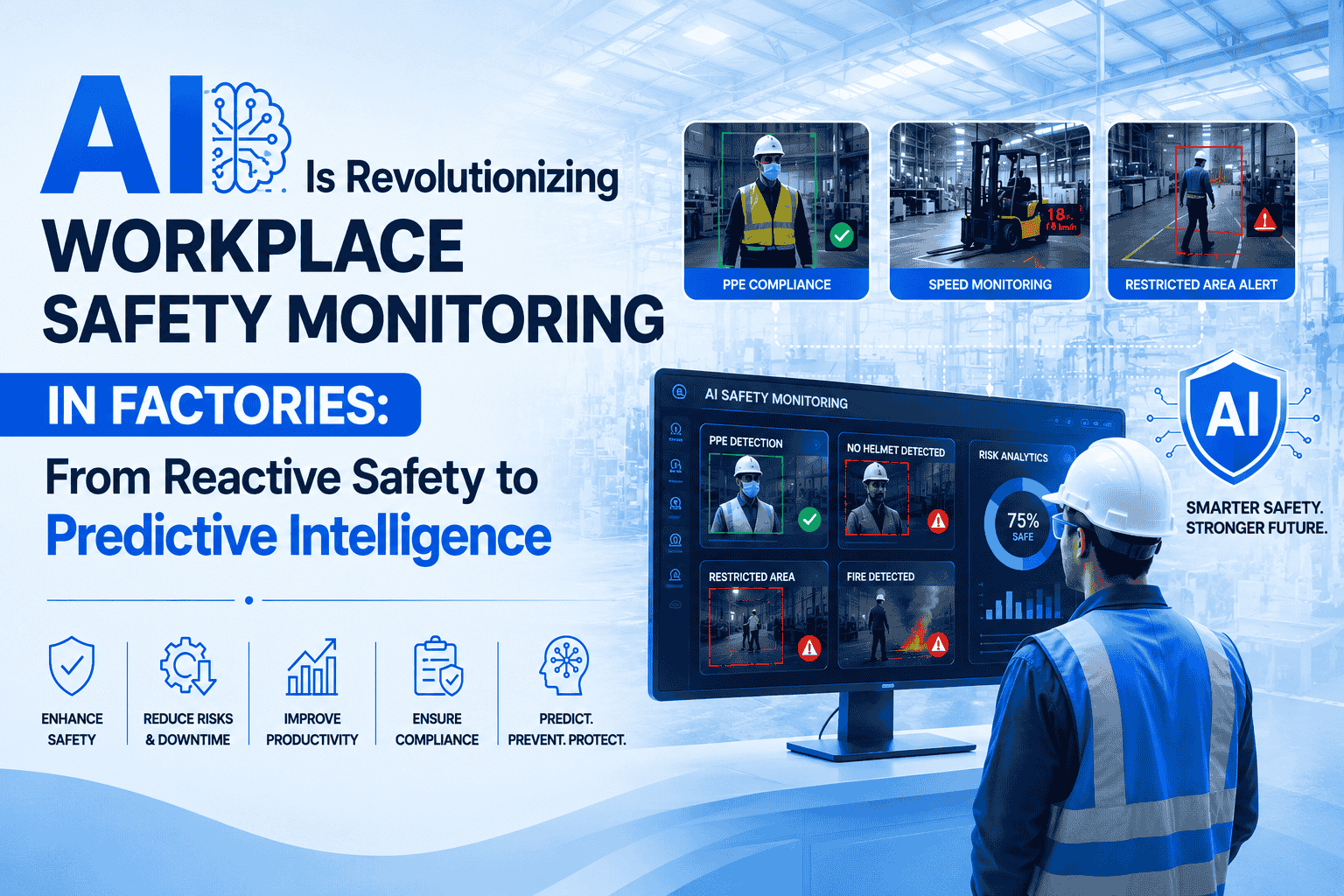
Process variability is not just a cost issue — it is a safety issue. In smelter environments, incorrect ladle lifting procedures and PPE non-compliance can lead to catastrophic incidents.
AI-based monitoring of ladle lifting operations prevented over 250 non-compliant lifting attempts in just three months, achieving 100% safety compliance. Simultaneously, OSHA compliance checks powered by vision AI ensured that all personnel in hazardous areas were wearing proper protective equipment.
The power of AI in reducing variability extends across the entire manufacturing value chain. In a typical copper smelting operation, 15 or more high-value AI applications can be identified:
| Process Area | AI Application | Variability Addressed |
|---|---|---|
| Raw Material Handling | Cross-bay material pick monitoring, foreign object detection, belt condition monitoring | Input feed variability, equipment wear, contamination |
| Smelter | Anode defect detection, flame monitoring, ladle level monitoring, refractory monitoring, crane guidance | Product quality defects, thermal variability, safety risk |
| Refinery | Anode short monitoring, nodule detection on cathodes | Electrical efficiency losses, quality defects |
| Continuous Casting | Tundish level monitoring, casting process monitoring, thermal profiling | Overflow and spillage, casting defects, thermal inconsistency |
| Captive Power Plant | Switchyard hotspot detection, coal size and moisture monitoring | Unplanned shutdowns, fuel efficiency losses |
Each application follows the same principle: capture visual data continuously, apply ML models to detect deviations in real time, and alert operators before variability cascades into lost production, quality defects, or safety incidents.
For copper manufacturers evaluating where to start with AI, three applications consistently deliver the highest return on investment within the shortest deployment window:
Improper raw material picking or dropping leads to unstable furnace chemistry, energy inefficiency, and metal recovery losses. AI-powered tracking monitors every loader movement across raw material bays, immediately alerting operators to any incorrect material pick or drop. The result: elimination of cross-feeding risk and a measurable reduction in input variability.
In copper smelting, 5–6% of anodes are typically rejected due to thickness variation, bending, surface cracks, or improper lug formation. Vision AI inspects anodes at three critical stages — before filling (mould health), after filling (cooling phase), and during demoulding (size and surface defects). With AI, the anode rejection rate can be reduced from 3.5% to as low as 1%, against a global benchmark of 2%.
Manual monitoring of hot metal levels in tundishes and ladles often results in overflows or spillages, each causing approximately 5 hours of shutdown. AI-based level monitoring provides automated alerts to operators, enabling proactive furnace tilt adjustments. Deployments have reduced spillage incidents from 2 per month to zero, while improving operator safety through continuous proactive monitoring.
A critical lesson from industrial AI deployments is that software alone does not lead to outcomes on the manufacturing floor. The hardware environment in smelters and refineries — extreme heat, sulphuric acid fumes, dust, and vibration — demands purpose-built solutions.
This full-stack approach — ruggedised hardware integrated with real-time vision analytics — is what separates solutions that work in a proof of concept from those that deliver sustained value in production.
One of the common objections to AI adoption in manufacturing is the perceived length and complexity of deployment. In practice, a well-refined methodology can take an AI application from purchase order to measurable impact in just 12 weeks:
| Phase | Timeline | Key Deliverable |
|---|---|---|
| Design and Engineering | Week 1–2 | Problem statement alignment, timeline confirmation |
| Procurement and Installation | Week 2–5 | Camera feeds available for processing |
| Model Building | Week 5–7 | ML model output review with operators |
| Testing and Field Trials | Week 8–10 | Hot trials with performance data |
| Adoption and Habit Forming | Week 10–12 | Daily reports, control room screens |
| Maintenance and Scale-Up | Week 13+ | Continuous monitoring and expansion |
The financial impact of AI-driven variability reduction is substantial and measurable:
| Impact Area | Quantified Result |
|---|---|
| Energy cost reduction | $30–45M/yr opportunity at 500 KTPA |
| Chemical dosage savings | 13–22% reduction in key dosing KPIs |
| Unplanned downtime | Near-complete elimination (20% production loss reduction) |
| Anode rejection rate | Reduction from 3.5% to 1% (vs. 2% global benchmark) |
| Spillage incidents | Reduced from 2/month to zero |
| Safety compliance | 100% compliance; 250+ non-compliant lifts prevented in 3 months |
| Aggregate savings | USD 20M+ per annum across 50+ deployments |
These results are not theoretical projections. They reflect actual production data from deployed systems at leading metals companies including Hindustan Zinc, Hindalco Birla Copper, ArcelorMittal, Nucor, JSW Steel, Tata Steel, and others.
In process manufacturing, the margin between market leadership and mediocrity is not determined by capital expenditure on the latest equipment. It is determined by the consistency with which that equipment is operated. Top-quartile producers have 6x lower process variability than bottom-quartile producers — process stability is the differentiator, not equipment.
AI provides the tools to achieve this stability: continuous 24/7 monitoring with no blind spots, real-time anomaly detection across material, equipment, and process parameters, and actionable alerts that enable operators to intervene before deviations become disruptions.
For manufacturers still relying on periodic manual inspections and reactive maintenance, the question is no longer whether to adopt AI, but how quickly they can move from pilot to production-scale deployment. The technology is proven. The business case is clear. The only variable left is the speed of adoption
Ripik.AI partners with the world’s leading metals manufacturers to deploy AI-led manufacturing excellence. From 10-week pilot to full-scale deployment, our full-stack platform — ruggedised hardware to real-time vision analytics — is purpose-built for smelters and refineries.
Visit www.ripik.ai or contact us at <a href="mailto:hello@ripik.aihello@ripik.ai to begin a site assessment.
Insights and perspectives from Ripik.ai's thought leaders
Fire and smoke incidents in the Raw Material Handling System (RMHS) represent a significant operational...
In modern steel plants, operational stability depends not only on equipment performance and automation...
Hotspot Monitoring of Electrical Equipments has emerged as the most effective technique to detect overheating,...
Discover how AI and vision analytics reduce process variability in manufacturing — cutting energy costs...
Learn how AI-driven stabilization reduces blast furnace variability by up to 70%, cuts coke rates by...
Accurate molten metal level measurement is vital for maintaining stability, safety, and quality in modern...
A powerful suite of intelligent agents working in sync to transform manufacturing with speed, precision, and autonomy.